
Common Questions About Commercial Plumbing in Millville
Yes. The 24/7 emergency line covers commercial properties, including overflowing floor drains, broken lines and sewage backups that stop a business from operating. For work that can wait, we book same-day appointments when available. We do not promise an arrival time, and you hear the price before we begin.
Yes. A property manager can call on behalf of the owner, give us the unit and access details, and ask for the price in writing before approving work. Tell us who is authorized to approve the job so tenants are not left waiting for a decision.
Grease trap service is planned work, and we book it as a visit, not an emergency. Call and tell us what kind of trap or interceptor you have. Millville has a grease and oil ordinance aimed at preventing blockages, especially from food businesses, so ask the city what applies to your kitchen.
A backflow assembly keeps water from flowing backward into the public supply. Some assemblies must be tested on a schedule, and a missed test can lead the water provider to act. Ask your water provider what applies to your building, then call us to book the test.
We can, but the honest answer is that it depends on where the pipes run. A leak in a slab or a hidden wall needs tracing before anyone cuts. Call us with the signs you see, such as a wet floor or a meter that keeps moving, and we will tell you what is realistic. See our leak detection page for the methods.
Stop using water in the building, close off the area and call. A floor drain overflow means the line downstream is blocked, and running more water only adds to the spill. If the building has a lift pump, tell us, because a failed pump causes similar symptoms.
We clear blocked drain lines on commercial sites, including exterior drains that clog with silt or debris. Tell us whether the drain is inside or outside and what it serves. Where a drain ties into the city system, we ask the owner to confirm who is responsible for the section that fails.
Under city guidance, the property owner maintains the sewer lateral. If the problem is in the lateral, the owner or business fixes it. The city Sewer Utility checks the main and will tell you what it finds, so call the Utility early in a backup.
Which problems are emergencies and which can be scheduled
Commercial plumbing splits into jobs that cannot wait and jobs that should be planned. This table shows where common problems fall.
| Business type | Common plumbing problem | Planned or emergency |
|---|---|---|
| Restaurant | Grease trap overflow, kitchen drain backup | Backup is an emergency, trap cleaning is planned |
| Retail shop | Restroom clog, slow floor drain | Usually same day, emergency if sewage rises |
| Office | Leaking supply line, running toilet | Leak is urgent, running toilet can be same day |
| Rental building | Tenant backup, water heater failure | Backups urgent, repairs by work order |
| Light industrial | Floor drain overflow, lift pump failure | Emergency when the floor floods |
| Any building with irrigation | Backflow assembly test | Planned and scheduled |
If your situation does not match a row, call. We would rather sort it out on the phone than send the wrong crew.
Before we arrive at your business
These steps limit damage and protect staff and customers.
Stop the water
Close the nearest fixture shutoff or the building main. Tell staff where it is for next time.
Clear the area
Keep people out of wet or sewage affected areas. Wet floors cause falls, and sewage is a health risk.
Protect stock and records
Move boxes, paper and equipment off the floor. Water spreads under shelves faster than it looks.
Stay away from electrics
If water reaches outlets, panels or equipment, do not touch them. Call us and tell us what is wet.
Drains, floor drains and restaurant lines
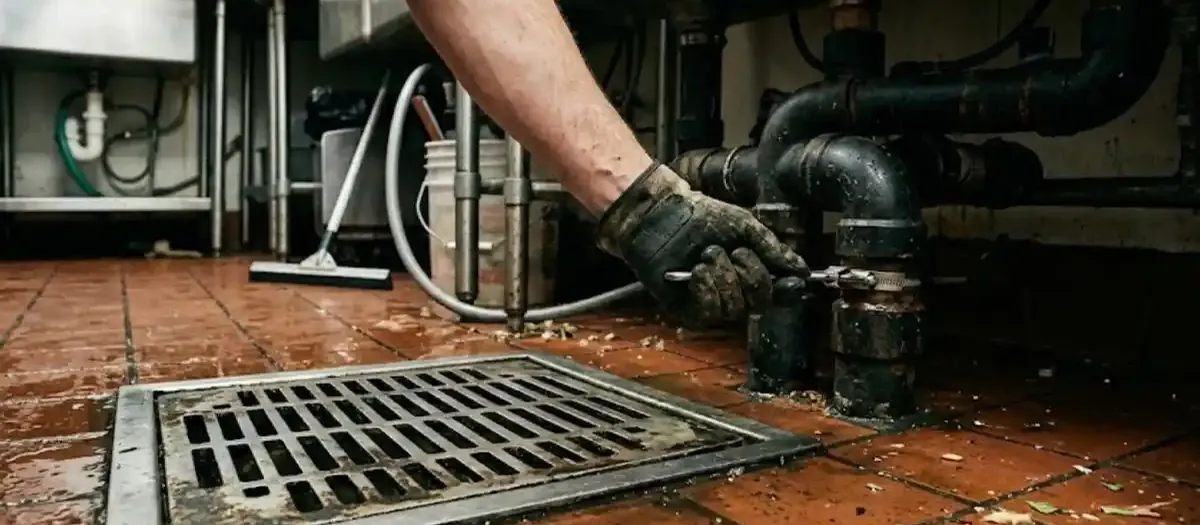
Commercial drains carry more than home drains do. Restaurant lines collect grease and food waste, and shop floor drains collect dirt, rags and silt. A blocked floor drain can flood a back room in minutes.
We clear these with cable machines and, where the line needs more than a cable can do, hydro jetting. We tell you which method fits your pipe and the blockage before we start. Frequent grease clogs call for a cleaning schedule, not another emergency visit.
Grease traps and the city ordinance
Millville has a grease and oil ordinance meant to prevent blockages from fats, oils and grease, with food businesses as the main target. A trap that is not cleaned on a schedule lets grease escape into your lateral and the city line beyond it. Ask the city what the ordinance requires of your kitchen.
Trap cleaning is planned work. We book it, agree on how often it needs repeating, and avoid the overnight call that comes when the trap overflows on a Saturday night service.
Backflow testing and other scheduled work
A backflow assembly protects the public water supply from contamination if pressure drops. Many commercial buildings and irrigation systems have one. A test shows whether the assembly still works, and a failed test means it needs repair or replacement.
Your water provider tells you whether testing is required and how often. Once you know, call us to book it in advance, because a missed deadline can be more expensive than the test itself.
Leaks in commercial buildings: what is realistic
Finding a hidden leak depends on where the pipe runs. A leak in an accessible mechanical room is simple to trace, while one under a slab or inside a finished wall takes more time and may not be worth locating if the cost exceeds the repair.
We tell you what we expect before booking a leak search. If tracing is unlikely to help, we say so and suggest options such as replacing a section of line.
Coverage along North High Street and Wheaton Avenue
Millville businesses cluster along North High Street, the downtown commercial corridor, and Wheaton Avenue, a commercial and industrial corridor served by Route 55 Exit 26. We dispatch from Millville, so both corridors are inside our regular service area.
Downtown buildings and industrial units have different plumbing needs. We ask about the building type on the first call so we send the right tools.
Working with property managers and landlords
Clear information up front helps tenants and keeps approval simple.
- Give us the building address, unit number and a contact who can let us in.
- Tell us who can approve the price, and whether the owner needs to sign off.
- Send photos of the problem and the nearest shutoff when you can.
- Share any past work on the same line so we do not repeat a fix that failed.
- Ask us to separate emergency repairs from items that can be scheduled.
- Keep tenants informed about water shutoffs and expected quiet hours.
Repair history and nearby towns
Businesses just north of us can also reach us through our page for a plumber in Vineland. Whether the building is in Millville or a nearby town, drain cleaning and emergency calls go through the same 24/7 line.
What changes the price
Every job gets a clear price before work starts. These are the things that move it up or down.
After-hours dispatch is priced differently from planned work booked for a weekday.
Occupied restaurants, tight mechanical rooms and roof access change the time on site.
A cable machine, a jetter and a camera each carry different equipment and labor.
Larger commercial pipes need heavier tools and more time than a home branch.
A cleared drain is one job. A broken section of pipe adds digging, parts and restoration.
Sources and standards
These are the references behind the guidance on this page. Rules and contacts change, so confirm details with the agency.
- New Jersey Uniform Construction Code, plumbing subcode (the Millville Construction Office posts the permit form)
- State Board of Examiners of Master Plumbers, Division of Consumer Affairs, for checking any plumber's license
- City of Millville Sewer Utility guidance on laterals, cleanouts and sewer overflows