
Step 1: Run the meter test
This single test tells you whether a leak exists. It does not tell you where.
- Stop all water useTurn off taps, the dishwasher, the washing machine and the ice maker. Make sure no one flushes a toilet.
- Read the meterFind the meter, usually near where the line enters the house, and note the numbers or watch the small triangle or dial that spins at any flow.
- Wait and compareWait at least fifteen minutes without using water, then read it again. Any change means water is moving through a pipe or fixture.
- Repeat after a longer gapSlow leaks may not show up in a short test. Try again after a few hours of no use if the first result is unclear.
Step 2: Check toilets with dye
Toilets are the most common silent leak. A worn flapper lets water trickle from the tank into the bowl without a sound, and the meter keeps moving.
Add a few drops of food coloring to the tank and do not flush for fifteen minutes. If color shows up in the bowl, the flapper or fill valve is leaking and needs replacing.
Repair of the part itself is simple and low-cost, but a leaking flapper can waste water for weeks before anyone notices.
Step 3: Isolate the leak by closing valves
With the meter still moving, close shutoff valves one fixture at a time: toilets, sinks, the washing machine, the water heater. Watch the meter after each one. When it stops, the last valve you closed is on the leaking branch.
If closing every fixture valve changes nothing, the leak is likely in the supply pipes inside a wall, floor or slab, or in the line between the meter and the house. That is a different class of problem from a dripping faucet.
Write down what you closed and what the meter did. A plumber can use that record to skip hours of guessing.
Signs of a leak you cannot see
Your house often tells you where to look before the meter does.
- A water bill that rises without any change in how many people use water or how much.
- Stains or soft spots on ceilings, walls or floors that grow, even in dry weather.
- A musty smell or visible mold in a closet, cabinet or basement corner.
- Warped baseboards, peeling paint or bubbling drywall away from any window or roof leak.
- The sound of running or hissing water when everything is turned off.
- Floor areas that feel warm or damp underfoot, which may point to a leak in a hot line.
- Low water pressure at some fixtures that is new and has no other explanation.
Which leak is it, and what does it point to?
Match your clue to the likely location. This narrows the search before you open any walls.
| Clue | Likely location | Next step |
|---|---|---|
| Meter moves, toilet dye shows color | Toilet flapper or fill valve | Replace the part |
| Meter stops when one fixture valve is closed | That fixture or its supply line | Inspect and repair that branch |
| Meter moves, all valves closed | Pipe in a wall, floor or slab, or the service line | Professional leak detection |
| Wet spot in yard, soggy ground, no rain | Line between meter and house | Water line inspection and repair |
| Ceiling stain below a bathroom | Supply or drain at the upstairs fixture | Open access and test |
| Hot spots or warm floor | Hot water line under the slab | Call promptly, shut off the heater supply |
If you cannot place the leak with these steps, that is the signal to stop poking at walls. Opening drywall without knowing the path often makes more damage than the leak.
Who owns the leak: the city side and your side
In Millville, the city-run Water Utility maintains the mains under the street. The pipe from the main to your house is the service pipe, and the city page does not spell out where its responsibility ends. Ask the Water Utility where its side stops, because that tells you whether a leak near the street is a city call or yours.
For an emergency affecting the street side, the Water Utility line is 856-825-7000 ext. 7613, and the office is open Monday to Friday, 7:00 am to 3:30 pm. If it is a sewer-side drain problem, the Millville Sewer Utility checks the main, but the homeowner is responsible for the lateral. Plumbing inside the house is always the owner's to fix.
Source type: City of Millville Water Utility web page and Sewer Utility page.
When acoustic detection is worth it
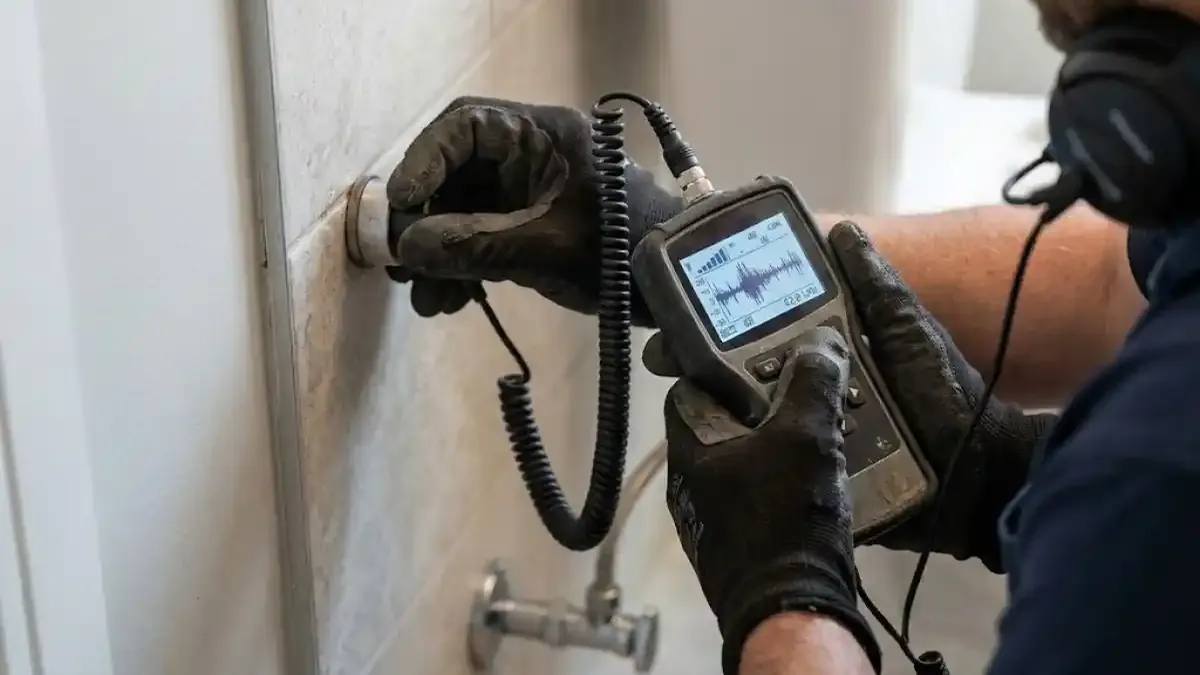
If the meter moves and the valve test points to a hidden pipe, guessing gets expensive. Professionals use listening equipment to hear the sound of water escaping, and thermal tools to spot temperature changes that show where it runs. That narrows the opening to a small area.
That is what our leak detection service does, and you can use it before any wall is cut. It also helps you decide whether the fix is a small repair or a bigger pipe issue.
If water is already pouring
A fast response limits the damage. Do these things first, then call.
Close the main valve
Turn the main shutoff clockwise to stop the flow. Know where it is before you need it.
Keep away from electrics
Do not touch outlets, switches or appliances near water. Shut off power at the panel only if you can reach it dry.
Open low taps
After shutting off the main, open a tap at the lowest point to drain the line and ease pressure.
Call for help
A split line is a burst pipe repair job. Our 24/7 emergency line is open, and we give a clear price before work starts.
Service across the area
We serve Millville and nearby towns, including Vineland and Port Norris. Same-day appointments are available when schedules allow.
Insurance may pay for sudden accidental damage but usually not for finding the leak or fixing the worn part. Read your policy or ask your agent.
Questions People Ask
Fifteen minutes with no water use is a good first check. Slow leaks can need a few hours, so repeat the test if the first one is unclear.
Yes. A leak inside a wall, under a slab or in the underground line can run for a long time before any stain appears. A bill that rises for no clear reason is a reason to run the meter test.
Yes. Water that moves through the flapper or fill valve is wasted, and it may not make much noise. The dye test is a quick way to confirm it.
Not before you know the path. Detection tools can often narrow the spot first, so the opening is smaller and the repair costs less in damage.
Coverage varies. Many policies cover sudden accidental damage but not the repair of a worn pipe, and some exclude the cost of finding it. Read the policy or ask your agent.
Start with the City of Millville Water Utility, since it maintains the mains. Ask where the city's responsibility ends and yours begins, then call a plumber for anything on your side.
Sources and standards
These are the references behind the guidance on this page. Rules and contacts change, so confirm details with the agency.
- New Jersey Uniform Construction Code, plumbing subcode (the Millville Construction Office posts the permit form)
- State Board of Examiners of Master Plumbers, Division of Consumer Affairs, for checking any plumber's license
- City of Millville Water Utility and its annual Consumer Confidence Report