
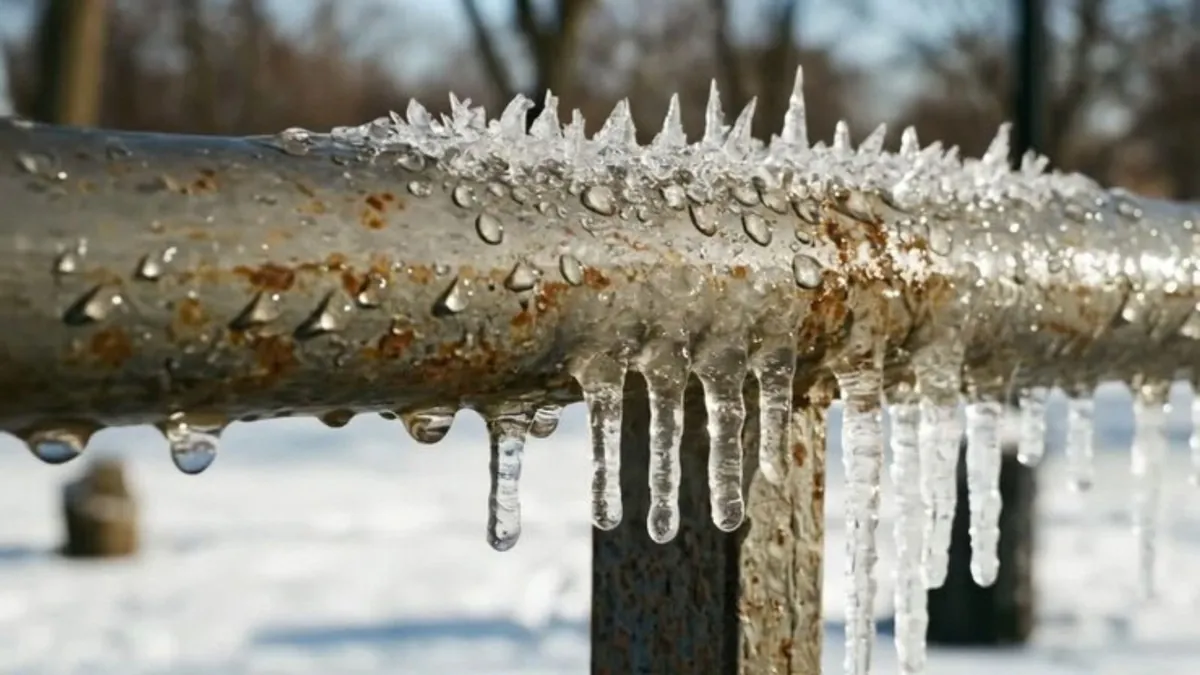
Frozen or burst: how to tell the difference
Frozen pipes often stay intact until the ice melts. Many splits only show up once the water starts moving again, so check before you thaw anything.
| What you see | What it usually means | What to do first |
|---|---|---|
| No water or a weak trickle at one faucet | Ice blocking that branch | Open the faucet, find the cold stretch, thaw slowly |
| No water anywhere in the house | Frozen main near the meter or entry point | Check the street side, then call the water utility or a plumber |
| Visible frost on the pipe | Ice inside, pipe still holding | Warm the pipe gently and watch it closely |
| A bulge or crack in the pipe | Ice has stretched or split the pipe | Shut off the main and call right away |
| Wet drywall, drip sounds or a stain | A split that is already leaking | Shut off the main, open taps, call for burst pipe repair |
| Water gushing when the ice clears | Split pipe now flowing | Close the main valve immediately |
If you are unsure which row fits, treat it as the more serious one. Shutting off the water costs you nothing, and a split pipe left running does damage by the minute.
How to thaw a frozen pipe safely
Work in this order. Every step is meant to keep a small problem from becoming a flooded room.
- Open the faucetTurn on the tap served by the frozen pipe. Moving water and a path for steam to escape help the ice clear as it melts.
- Find the cold sectionRun your hand along the pipe from the faucet back toward the wall or floor. The spot that feels coldest, or shows frost, is usually where the ice sits.
- Apply gentle heatUse a hair dryer on low, a heating pad, or towels soaked in warm water. Start nearest the faucet and work back toward the blockage.
- Keep the water off the electricsDo not stand in water while using any plug-in heater or dryer. If a wet outlet or cord is in reach, do not touch it and shut off power at the panel if you can do so safely.
- Check for leaks as flow returnsWatch the pipe, the ceiling below it and the floor around it. If water appears where it should not, close the main valve and call.
What never to use on a frozen pipe
Skip propane torches, blowtorches, kerosene heaters, charcoal and anything with an open flame. Pipe sits against wood framing and insulation, and a flame near either can start a fire you will not see until later.
Also skip boiling water poured over pipe, and do not run a space heater unattended in a crawlspace. Slow, even warmth is safer for the pipe and the building.
Where pipes tend to freeze in a house
Freezing follows cold air, not pipe size. Lines inside exterior walls, runs along a rim joist, pipes in a crawlspace, and anything in an unheated garage, porch or utility room are the usual suspects. Outdoor hose bibs and the short pipe feeding them are especially exposed.
Kitchen and bathroom sink lines on an outside wall deserve a look as well, because cabinet doors keep warm room air away from them. Opening those doors on a hard-freeze night lets heat reach the pipe.
Pipes that have frozen once often freeze again in the same place. If the same faucet quits every cold snap, the cause is the pipe route or missing insulation, and that is worth fixing before the next freeze.
Steps to take before a cold snap
A short walk-through a day or two ahead is cheaper than any repair. Do these while the weather is still mild enough to work comfortably.
- Disconnect garden hoses and, where your setup allows, shut off and drain the supply to outdoor faucets.
- Open cabinet doors under sinks on outside walls so room heat reaches the pipes.
- Let a thin stream of cold water run overnight at the tap farthest from where water enters the house.
- Add foam pipe sleeves to exposed lines in crawlspaces, garages and basements.
- Seal drafts around pipe entry points, rim joists and vents with caulk or spray foam.
- Keep the thermostat steady, even if you are away, rather than setting it very low.
- Know exactly where your main shutoff valve is and that it turns without a fight.
After the ice clears: check before you relax
A pipe can hold while frozen and leak once thawed. Leave the faucet open a few minutes, then close it and look at the pipe, the joints and the surfaces around and below it. Check again an hour later.
Look for stains on ceilings, a musty smell, or a water meter that keeps moving when everything is off. Those point to a hidden split, and our burst pipe repair service covers finding and fixing it.
If water arrives at the house from the street and the ice is out in the yard rather than in the walls, the problem sits in the line underground. That falls under water line repair, not a quick thaw at the faucet.
If there is no water at all in Millville
Millville's water comes from ten city wells, and the city runs the Water Utility, which maintains the mains under the street. If a whole block has lost water, the issue may be on the city side, so a call to the utility is worth making before you start taking pipes apart. Its emergency line is 856-825-7000 ext. 7613, and its office is open Monday to Friday, 7:00 am to 3:30 pm.
The pipe from the main to your house is called the service pipe. The city page does not spell out where its responsibility ends and yours begins, so ask the Water Utility directly. That answer decides whether a frozen or split line near the street is a call to the city or to a plumber.
Source type: City of Millville Water Utility web page and 2026 Consumer Confidence Report.
When to stop and call a plumber
Call when you cannot find the frozen spot, when it sits behind a finished wall, or when the pipe is already bulged or cracked. Call if thawing does nothing after a reasonable try, or if you see any water where it should not be.
Our 24/7 emergency line is open for burst and leaking pipes, and we serve Millville and nearby towns with a clear price before work starts. If the water is running, close the main valve first, then call. Homeowners in Bridgeton and Vineland can reach us the same way.
Questions People Ask
Yes. Ice expands and can split a pipe without any outward sign. The split often leaks only after the ice melts and water starts to move again, so check the pipe and surrounding area once flow returns.
It is a gamble. Pressure builds between the ice and the closed tap, and a weak spot can fail. Opening the faucet and warming the pipe slowly is safer than waiting, and shutting off the main is the better move if you will be away.
Not always. If the pipe is intact and you can thaw it while watching, you can keep the main open. Shut it off the moment you see water, a bulge, a split, or if you must leave the house.
Only with care. Keep it clear of insulation, wood and standing water, and never leave it running while you are out. A hair dryer aimed at the cold section is easier to control.
Policies vary. Many cover sudden accidental damage but not the failed pipe itself or neglect. Read your policy or ask your agent, and take photos before cleanup.
Start with the City of Millville Water Utility, since it maintains the mains. Ask it where the city's responsibility ends. If the trouble is on your side of that point, call a plumber.
Sources and standards
These are the references behind the guidance on this page. Rules and contacts change, so confirm details with the agency.
- New Jersey Uniform Construction Code, plumbing subcode (the Millville Construction Office posts the permit form)
- State Board of Examiners of Master Plumbers, Division of Consumer Affairs, for checking any plumber's license
- City of Millville Water Utility and its annual Consumer Confidence Report