
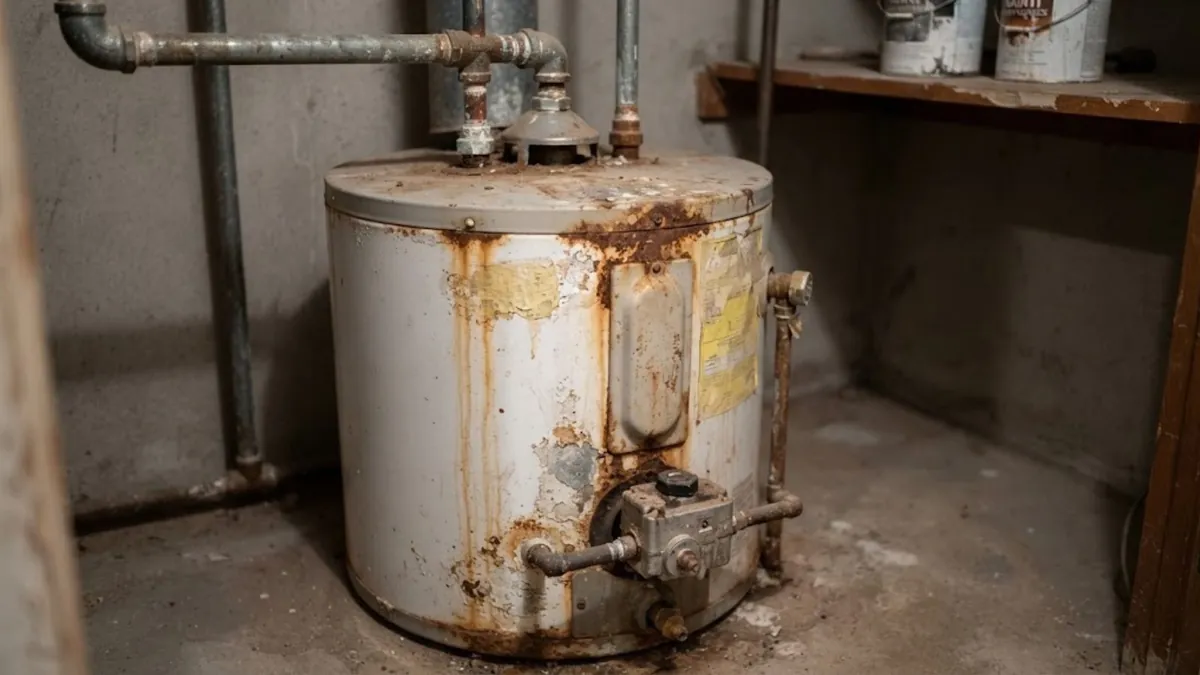
The short answer by heater type
Different heaters wear out in different ways. Use this table as a starting point, then read the signs below for your own unit.
| Heater type | General replacement window | What usually ends it |
|---|---|---|
| Standard gas tank | Many are replaced around 10 to 15 years | Tank corrosion, burner or valve faults |
| Standard electric tank | Many are replaced around 10 to 15 years | Tank corrosion, repeated element failures |
| Tankless | Often longer than a tank, with maintenance | Heat exchanger wear, scale, board faults |
| Hybrid heat pump | Varies by model, follow the maker | Compressor, fan or sensor failure |
| Any unit with a seam leak | Replace now | Inner tank has failed |
These are general ranges, not promises. A well kept tank can pass them, and a neglected one can fall short.
Signs the tank is near the end
Look for several of these together. One alone may be a repair.
- Moisture, rust stains or a small puddle at the base of the tank.
- Rust colored hot water that does not clear after a minute of running.
- Rumbling or popping from sediment that a flush does not cure.
- Hot water that runs out much faster than it did when the heater was new.
- Corrosion around the fittings, the relief valve or the drain valve.
- Two or more repairs in a short stretch, even if each one was small.
- A manufacture date on the label that puts the tank well past the usual window.
The anode rod and why it sets the clock
A tank heater has a sacrificial anode rod that corrodes so the steel tank does not. When the rod is used up, the tank wall begins to rust, and the rod cannot be replaced after the damage is done. Checking the rod when the tank is middle aged can add years, if it is still sound inside.
If the tank has never had a rod check and is already near the old end of its range, putting time into the rod may not pay off. A plumber can look at the heater and tell you whether a rod swap is a sensible bet or a waste.
Sediment, scale and noisy tanks
Sediment collects at the bottom of the tank and insulates the water from the burner or lower element. That makes the heater work harder and can cause popping sounds. Flushing can help, though on a very old tank, stirring up buildup can reveal a leak that was plugged by sediment.
Hard water regions see this faster. Millville is on the softer end, so a tank here is less likely to be strangled by scale and more likely to wear out from corrosion and age.
A simple rule for repair versus replace
When a heater acts up, run through these questions in order.
- Where is the water coming from?A leak from the tank body means replace. A leak from a fitting or valve can usually be repaired.
- How old is the tank?Check the label for the manufacture date. Past the usual window, a repair buys less time.
- How many repairs so far?One repair on a younger tank is ordinary. Repeated repairs signal the whole unit is tired.
- What is the cost of failure?A heater in a finished basement or above living space has a higher cost of leaking than one in a bare garage, which argues for replacing sooner.
Safety checks before you wait any longer
Age is only one reason to act. Some warning signs mean the unit should be shut down now, not at the end of its expected life.
- Smell gas near a gas-fired heater: leave the building, then call 911 and the gas utility from outside.
- Water pooling under the tank or dripping from the tank seams: shut off the cold supply valve and call a plumber.
- The temperature and pressure relief valve discharges or its pipe drips: have it checked the same day.
- Rust-colored hot water only: the tank lining may be failing, so plan the replacement soon.
- Scorch marks, a scorched smell or soot around the burner area: turn the unit off and do not relight it.
- Rumbling or popping from the tank: sediment is likely, and a flush or replacement decision should not wait long.
Replacing before it fails
Planned replacement is calmer than an emergency swap. You choose the unit, the day and the fuel, and you are not mopping a floor at night. If your heater is old and sits in a finished area, replacing early is a reasonable way to avoid a larger water damage bill later. Water damage from a slow leak is also often not covered, which is another reason not to wait.
What a replacement decision looks like in Millville
The 2026 Consumer Confidence Report lists Millville's carbonate hardness at 29 ppm, which is soft water. That means scale buildup in a tank is a smaller driver of wear here, so judge your heater by its age, rust and leaks rather than assuming scale is to blame. If you have a water softener, it is mostly for other reasons.
Permit rules depend on the job, so ask the Millville Construction Office before changing fuel type or moving the heater. If you are not sure whether your water issue is the heater or the city supply, the Millville Water Utility can help sort that out.
Source type: City of Millville Water Utility web page and 2026 Consumer Confidence Report.
Tankless and heat pump units
A tankless unit has no tank to rust through, so its life depends on the heat exchanger and its electronics. Regular maintenance, such as flushing, is what keeps these running. Hybrid heat pump heaters have a tank plus a compressor, so either part can end their life.
In both cases, follow the manufacturer's service schedule and instructions. A repair is the usual first step, and replacement comes when the main components are failing.
Questions People Ask
Yes, some do, especially with good maintenance and a healthy anode rod. But a tank that old is a higher risk for a leak, and the age alone may be a reason to plan for a replacement.
It depends on the repair. A cheap, simple fix such as a thermostat or valve may be fine. A leak from the tank, or a second repair in a short time, points toward water heater replacement instead. Our water heater repair page covers what can be fixed.
Look at the rating label on the tank for a serial number. Many makers encode the month and year in it. If you cannot decode it, the manufacturer's customer line can help.
Softened water reduces scale, which can help the heater. But Millville's water is already soft, so a softener adds less benefit for the heater here. The tank still ages from corrosion.
The decision signs are the same. Water quality, venting and access can differ by address, so check with your local water utility. See our pages for Vineland and Port Norris for service in those areas.
Sources and standards
These are the references behind the guidance on this page. Rules and contacts change, so confirm details with the agency.
- New Jersey Uniform Construction Code, plumbing subcode (the Millville Construction Office posts the permit form)
- State Board of Examiners of Master Plumbers, Division of Consumer Affairs, for checking any plumber's license
- Manufacturer installation and service instructions for your specific unit