
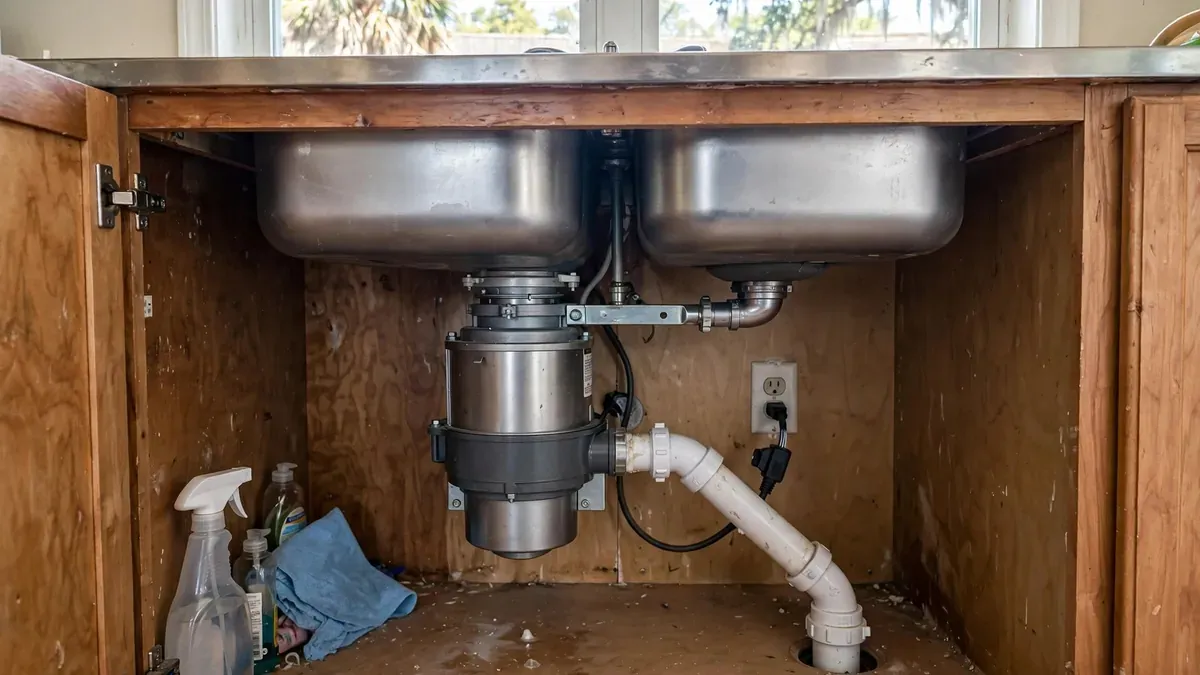
Why a swap and a first install are different jobs
A swap reuses the sink flange opening, the drain connection and the power supply that are already there. You disconnect the old unit from its mounting ring, lower it, and hang the new one on the same hardware or a matching ring. Most of the work is lifting a heavy unit into place while lying under a cabinet.
A first install starts from nothing. You need power at the right spot, usually a switched outlet or a hardwired connection, and a drain setup that works with a disposal outlet. Kitchen sink flanges are also made differently for disposals, so the strainer in your sink may need to be replaced as part of the job.
Match your situation to the difficulty
Use this as a quick filter before you commit to a weekend of work. Find the row that sounds like your kitchen.
| Your situation | How hard it is | What usually causes trouble |
|---|---|---|
| Replacing a disposal with a similar one | Manageable for a handy person | Weight of the unit, stuck mounting ring, old putty |
| Replacing with a larger or different brand | Moderate | Mounting hardware does not match, outlet pipe height changes |
| First disposal, outlet already under the sink | Moderate to hard | Drain trap must be reworked, flange swap needed |
| First disposal, no outlet or switch nearby | Hard, often a two trade job | New electrical work should be done by a qualified electrician |
| Double bowl sink with a dishwasher | Moderate to hard | Extra drain tee, dishwasher hose connection, leaks at joints |
If your row says hard, the plumbing is only half the problem. Wiring a new circuit or outlet is electrical work, and it is a good place to bring in a licensed professional.
Check these before you buy a unit
A few minutes of looking under the sink saves a return trip to the store.
- Look for an outlet under or beside the sink and a wall switch that controls it.
- Measure the cabinet space below the drain, since some units are tall and need clearance.
- Check whether your sink has a standard three and a half inch drain opening.
- Find out if a dishwasher drain hose connects to the old disposal or to the sink drain.
- Read the manufacturer instructions for your model before you start, because mounting systems differ.
- Know where your breaker panel is and which breaker feeds the kitchen outlets.
The install at a high level
Every model comes with its own instructions, and those win over any general guide. This is the usual order of work.
- Cut the powerSwitch off the breaker and confirm the outlet is dead before touching a cord or wires. Never rely on the wall switch alone.
- Remove the old partsDisconnect the trap and drain pipes, then release the old disposal from its mounting ring or take out the sink strainer if you are doing a first install.
- Mount the flange and ringSeat the new flange with plumber's putty or the gasket the maker supplies, then attach the mounting assembly from below and tighten it evenly.
- Hang the unit and connect the drainLift the disposal onto the ring, lock it, and line up the discharge outlet with the trap. Connect the dishwasher hose if there is one.
- Power up and testRestore power, run cold water, switch the unit on and watch every joint for drips. Tighten gently and test again.
The dishwasher plug that people forget
Many disposals have a small knockout plug inside the dishwasher inlet. If a dishwasher drains through the disposal, that plug has to be removed before the hose goes on. If you forget, the dishwasher cannot drain, and water pools in the bottom of the machine.
Knock the plug out with a screwdriver and a light tap, and take the loose piece out of the disposal chamber so it does not jam the grinder. If no dishwasher connects to the unit, leave the plug in place.
Where leaks and noises come from
Most leaks after a new install show up at one of three places: the sink flange seal, the connection between the disposal and the trap, or the dishwasher hose clamp. Run water for a full minute and dry each joint with a paper towel. A damp towel tells you which joint is weeping.
A humming unit that will not spin usually has something wedged in the grinder, or the reset button on the bottom has tripped. If a disposal that used to work now leaks or jams repeatedly, a repair visit for garbage disposal repair may be cheaper than replacing it. A grinding noise that never goes away points to a worn unit or a loose part inside.
Permits and drains in Millville
Permit rules depend on the job, and the city does not list on its public page which jobs need a plumbing permit. The Millville Construction Office at City Hall posts the state plumbing subcode form, so a quick call before a first install, especially one that changes drain piping or adds wiring, tells you whether paperwork applies.
Millville also has a grease and oil ordinance aimed at keeping fats, oils and grease out of the sewer system, and it is aimed most at food businesses. A disposal does not make pouring grease down the sink acceptable, because grease cools and coats the pipe past the trap. Wipe pans with a paper towel first and the drain line stays clearer.
Source type: City of Millville Construction page and Sewer Utility page.
When hiring out makes more sense
Hire help when the job needs new electrical supply, when the drain layout has to change, or when the cabinet space is tight enough that one wrong move cracks a pipe. A professional first install also costs less time because the right fittings are on hand. For a job that mixes drain changes and new fixtures, our plumbing installation service covers the plumbing side and tells you the price before work starts.
We serve Millville and nearby towns, and the same dispatch reaches Vineland and Bridgeton. If you are unsure which row of the table you are in, describe your sink on a call and we will tell you honestly whether it is a weekend project.
Questions People Ask
Yes for a straight swap if you are comfortable lifting about the weight of a small bag of cement and working under a cabinet. A first install is harder, because the electrical supply and drain layout usually change.
A swap often takes a couple of hours for a first timer. A first install can fill a weekend, mostly because of the electrical and drain changes. Plan extra time for a trip to the store.
Only if there is no outlet or switch in the right spot. Adding power is electrical work, and a licensed electrician is the right person for it. Plug in models still need a grounded outlet.
Usually the trap is sloped wrong, the dishwasher plug is still in, or a gasket is out of place. Check the plug first, then see whether water drains freely when the unit is off.
A short call is sensible, because permit rules depend on the job and the city page does not spell out which jobs need one. Ask about drain changes and any new wiring. The office posts the state plumbing subcode form, which is the paperwork if one is needed.
Sources and standards
These are the references behind the guidance on this page. Rules and contacts change, so confirm details with the agency.
- New Jersey Uniform Construction Code, plumbing subcode (the Millville Construction Office posts the permit form)
- State Board of Examiners of Master Plumbers, Division of Consumer Affairs, for checking any plumber's license
- City of Millville Sewer Utility guidance on laterals, cleanouts and sewer overflows