
Common Questions About Sump Pump Repair in Millville
Yes. Our emergency line is open 24/7, and storms do not keep office hours, so neither do we. We cannot promise an exact arrival time, but the dispatcher will tell you what to do while you wait and book the earliest appointment available.
Usually one of three things. The float switch may be stuck in the on position, the check valve may be letting water fall back into the pit after each cycle, or the incoming water is truly more than the pump can keep up with.
Check that the pump is plugged in, that the outlet has power, and that a tripped breaker or GFCI outlet is not the reason. Then lift the float by hand if it is safe to reach without touching wet cords.
A failed float switch or a bad check valve is often worth repairing. A pump that is old, rusted, noisy or has tripped repeatedly usually costs more to keep fixing than to replace.
A backup helps whenever a storm can knock out your power at the same moment water is rising. It does not replace a healthy main pump, and the battery needs periodic checks to stay useful.
We cannot answer that for your lot. Discharge rules depend on where the water ends up and on local requirements, so ask the Millville Construction Office before you change where the pipe runs.
A neighbor with a similar setup can tell you what has worked on your street, but the city office has the final word.
Pump running nonstop, silent, or basement water rising?
These three symptoms look different, but they point to a short list of causes. A pump that runs nonstop is usually fighting a stuck float, a failed check valve or more water than it can handle. A silent pump is usually a power problem, a dead switch or a burned-out motor. Rising water with a running pump often means a clogged intake or a blocked discharge line.
That is the work of sump pump repair: reading which symptom you have, testing the parts in order, and fixing only what is broken. We start with the cheapest and fastest checks, like power and float movement, before we pull the pump or talk about replacement.
When a failed sump pump is an emergency
A dead pump in dry weather can wait for a daytime visit. A dead pump with rain coming, water in the pit near the top, or water already on the floor cannot. Call the 24/7 emergency line and use these steps while you wait.
Stay away from live electricity
Do not wade into water that touches outlets, cords, a furnace or the panel. If you cannot reach the breaker without standing in water, leave it alone and tell the dispatcher.
Move things up and out
Lift boxes, rugs, stored papers and electronics onto shelves or upstairs. Water damage grows by the hour, so save what you can reach safely.
Check the simple causes
From a dry spot, look at whether the pump is plugged in and the outlet works. Do not pull a plugged-in pump out of the pit by its cord.
Take photos for your insurer
Photograph the pit, the pump, the water level and any damaged items before you clean up. It makes a claim conversation easier later.
Symptoms, causes and fixes at a glance
Use this table to see what is probably wrong. We confirm the cause at the pit first.
| Symptom | Likely cause | Typical fix |
|---|---|---|
| Pump runs constantly, pit stays empty | Float stuck on, or check valve stuck open | Free or replace the float, replace the check valve |
| Pump runs, but water level keeps rising | Clogged intake or blocked discharge line | Clean the intake, clear or repair the discharge pipe |
| Pump hums but does not move water | Seized impeller or failing motor | Clean the impeller if possible, otherwise replace the pump |
| Pump will not turn on at all | No power, tripped GFCI or dead switch | Reset power, replace the switch or the pump |
| Pump cycles on and off every few seconds | Check valve missing or failing, or float set too low | Install a working check valve, reposition the float |
| Pump fails only during storms | Power outage or pump too small for the load | Add a battery backup, size up the pump |
If two rows describe your pump, the cause is often the older, cheaper part failing first, and the pump itself is still sound.
Float switch, check valve and discharge line
The float switch is the pump's trigger. It rises with the water and turns the pump on, then drops and turns it off. Debris, a snagged cord or a worn switch can leave the pump stuck on or never starting.
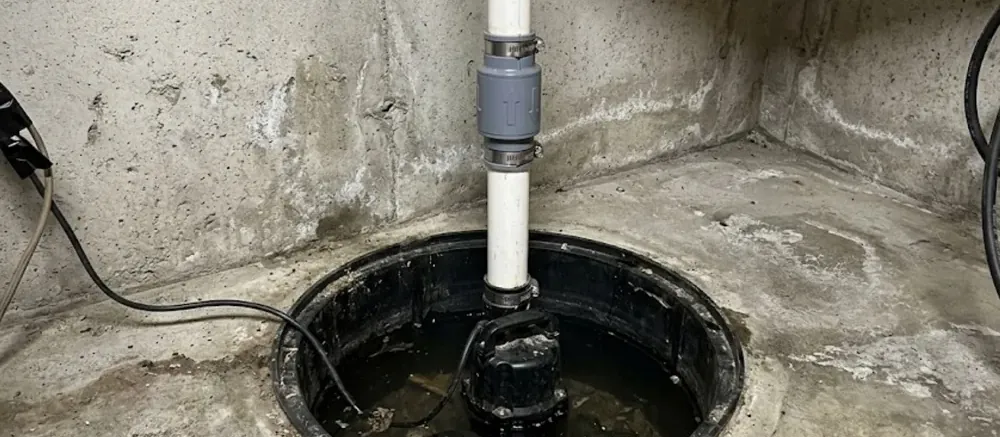
The check valve sits on the discharge pipe just above the pump and keeps pumped water from running back into the pit. When it fails, the pump re-pumps the same water over and over, which wears the motor and makes it seem like the pump never rests. A healthy valve often gives a short clunk as it closes.
The discharge line carries water out of the house and away from the foundation. A kinked, frozen, clogged or disconnected line can make a good pump look broken. If water leaving the line returns toward the house, or the pipe gets blocked with debris or roots, drain cleaning methods or a line repair may solve it.
Power outages, storms and battery backup
Heavy rain and power loss often arrive together, which is exactly when a plug-in pump goes quiet. A battery backup pump sits beside or inside the pit and takes over when the main pump loses power or fails. It does not make the basement waterproof, and it only runs as long as the battery holds a charge.
If you add one, follow the manufacturer's instructions for sizing, wiring and battery care. Test it on a schedule, because a backup nobody has checked in a year may not start when it counts.
Repair or replace the pump?
Repair makes sense when one part has failed and the rest is sound, like a float switch, a check valve or a short section of discharge pipe. Replacement makes more sense when the pump is rusted, loud, overheating, undersized for the pit, or has failed more than once.
We tell you which way we lean and why, and you choose with the price in front of you.
Water in the basement but the pump is fine
Sometimes the pump is doing its job and water still comes in. Seepage through walls or floor joints, a leaking pipe, or a floor drain that backs up can all look like a pump failure. A leak detection visit helps separate a plumbing leak from groundwater.
If the water keeps returning through the walls or floor, the real fix may be drainage work instead of a pump. Our basement waterproofing page explains which parts of that work are plumbing and which belong to another trade.
Local notes for Millville homes
We have no verified soil or water table facts for individual Millville streets, so we will not guess. Ask a neighbor how their pump behaves in heavy rain, and ask the Millville Construction Office about discharge rules and permits.
We serve Millville and nearby towns, including homes south of the city covered on our Port Norris plumbing page. The same emergency line reaches us wherever you are.
What changes the price
Every job gets a clear price before work starts. These are the things that move it up or down.
Swapping a float switch or check valve costs less than a new pump. A new pump also includes labor to pull the old one and reset the pit.
Submersible and pedestal pumps differ, and horsepower changes with how much water your pit has to move.
Adding backup protection adds equipment and setup time on top of the main pump work.
A blocked, damaged or poorly routed discharge pipe may need cleaning or partial replacement before the pump can do its job.
A tight pit, a flooded basement or an after-hours call can change the time and equipment the job needs.
Sources and standards
These are the references behind the guidance on this page. Rules and contacts change, so confirm details with the agency.
- New Jersey Uniform Construction Code, plumbing subcode (the Millville Construction Office posts the permit form)
- State Board of Examiners of Master Plumbers, Division of Consumer Affairs, for checking any plumber's license
- City of Millville Sewer Utility guidance on laterals, cleanouts and sewer overflows