
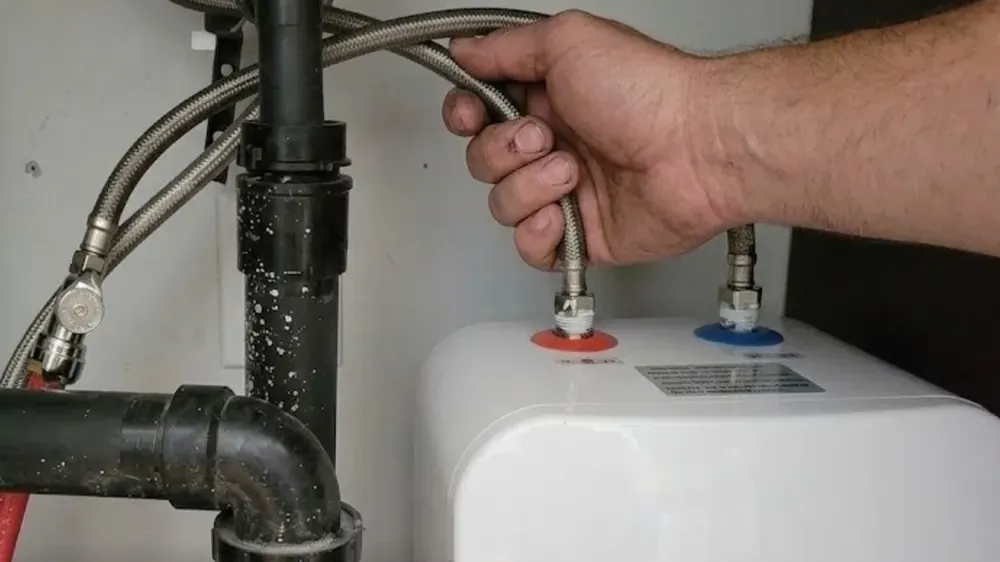
What a 120V point-of-use heater actually does
Water has to gain a lot of heat to go from cold to usable, and heat takes power. A plug-in 120 volt unit has a low power ceiling, which means it can only heat a small flow. The tradeoff is simple: the more water you push through, the less the temperature rises.
In practice that suits a bathroom sink or a bar sink where you want warm water quickly and use it in short bursts. It does not suit a kitchen sink where you fill a pot and rinse dishes for several minutes. Many of these units are built with a small flow rate for exactly that reason.
Some small models also store a little hot water in a mini tank, which helps with short bursts but is a different product. Read the label to see which type you are looking at.
Where it makes sense and where it does not
Use this table to match the unit to the job before you buy anything.
| Use | Fits a 120V under sink unit? | Why |
|---|---|---|
| Handwashing at a far bathroom | Usually yes | Low flow, short use, and the unit sits close to the tap |
| Quick rinse at a bar or prep sink | Usually yes | Small volume and short bursts are what these are built for |
| Kitchen sink with dishes and pots | Sometimes, with limits | Flow may drop as hot water use runs longer |
| Shower | No | Needs far more heating capacity than a plug-in unit has |
| Washing machine or dishwasher | No | Large volume and often a dedicated hot supply |
| Whole house hot water | No | Needs a whole-home heater of the right size |
If your real need is hot water at every tap, skip the point-of-use idea and look at a whole-home heater instead.
The outlet and circuit reality
A plug-in unit still pulls real electrical load while it heats. The outlet under a sink may share a circuit with other things, and the circuit rating, the wire gauge and the presence of ground fault protection all matter. A unit that is plugged into the wrong place can trip a breaker or run poorly.
Some products ask for a dedicated circuit, and others are hardwired. Whether yours needs one depends on the model, so check the manufacturer installation instructions first. Ask a licensed electrician to review the circuit, because we do not want you guessing about load or wiring.
Water and electricity are a dangerous pair. If you see water near the unit, an outlet or a cord, do not touch it. Shut off power at the breaker only if you can reach the panel without standing in water, and call for help.
Before you buy: a quick checklist
Run through these points first. Most regret with these units comes from skipping them.
- Write down what you will use the sink for and for how long each time, since flow and duration decide the fit.
- Read the label for the flow rate and temperature rise, and check them against your coldest incoming water.
- Find the outlet nearest the unit and ask an electrician if the circuit can carry the load.
- Check that the cabinet has room, with space around the unit and access to shutoff valves.
- Confirm the unit has the required safety features, such as a temperature limit and pressure relief when needed.
- Plan for the plumbing connection: hot and cold supply lines, shutoffs and a check on whether the faucet works with it.
- Keep the manual, because maintenance and filter cleaning instructions are tied to the model.
Where to put it and how it connects
The best location is as close to the tap as possible. Short pipe runs mean less cooled water sitting in the line and a faster arrival of warm water. A unit installed far from the faucet gives up much of the benefit.
Most are installed with the hot output feeding the faucet and a cold supply tee from the existing shutoff. The unit also needs to be reachable for service, so avoid burying it behind a stack of cleaning supplies and pipes. If your faucet drips or struggles with low pressure, sort that out first, and our faucet repair page explains what we look at.
When a whole-home tankless unit is the right answer
If the reason you are shopping is that hot water takes too long everywhere, a small sink heater is only a patch. A whole-home unit solves flow for the whole house, but it needs a gas supply or a large electrical load, and it has to be sized for your busiest hour. That is a bigger decision with a bigger installation.
Our tankless water heater page covers install, repair and flushing, and it is a good next read before you choose between a point-of-use unit and a whole-home one.
What Millville's incoming water means for a small unit
The City of Millville Water Utility says its supply is groundwater only, drawn from ten wells in the Cohansey and Kirkwood aquifer. Incoming water is typically colder in winter, so a unit that looks adequate in July may deliver cooler water in January. When you compare models, judge them on cold-weather performance, not summer numbers.
The same city report lists soft water at 29 ppm of carbonate hardness. For a small heater with narrow passages, softer water means less scale to worry about than in hard water areas, though the maker's maintenance steps still apply.
Source type: City of Millville Water Utility web page and 2026 Consumer Confidence Report.
Common mistakes to avoid
The first is expecting a shower from a sink unit. The second is plugging into an outlet that is already doing too much. The third is mounting the heater far from the tap and wondering why the wait is long.
A fourth is ignoring the faucet. Aerators clog and old cartridges restrict flow, and a restricted flow can make a heater switch off or underperform. Fixing the tap often costs less than replacing a heater that was never the problem.
Questions People Ask
No. A plug-in unit lacks the power to heat the flow a shower uses. Use a whole-home tankless or tank heater for showers.
Often it is wise to ask one. The circuit, outlet type and ground fault protection need to suit the unit, and some models require a dedicated circuit or hardwiring. The manual tells you what yours needs.
It can help at the one sink it serves, because it sits close to the tap. It does nothing for the rest of the house, so the long wait elsewhere remains.
If the flow is weak even on cold, the faucet or its aerator may be clogged. If water drips or the handle feels loose, the cartridge may be worn. A faucet check is simple and worth doing before buying a heater.
Permit rules depend on the job, so ask the Millville Construction Office. The city posts the state plumbing subcode form on its construction page, and a plug-in unit may be treated differently from a hardwired or whole-home one. If you are across the line in Bridgeton or Port Norris, your township office is the one to ask.
Sources and standards
These are the references behind the guidance on this page. Rules and contacts change, so confirm details with the agency.
- New Jersey Uniform Construction Code, plumbing subcode (the Millville Construction Office posts the permit form)
- State Board of Examiners of Master Plumbers, Division of Consumer Affairs, for checking any plumber's license
- Manufacturer installation and service instructions for your specific unit