
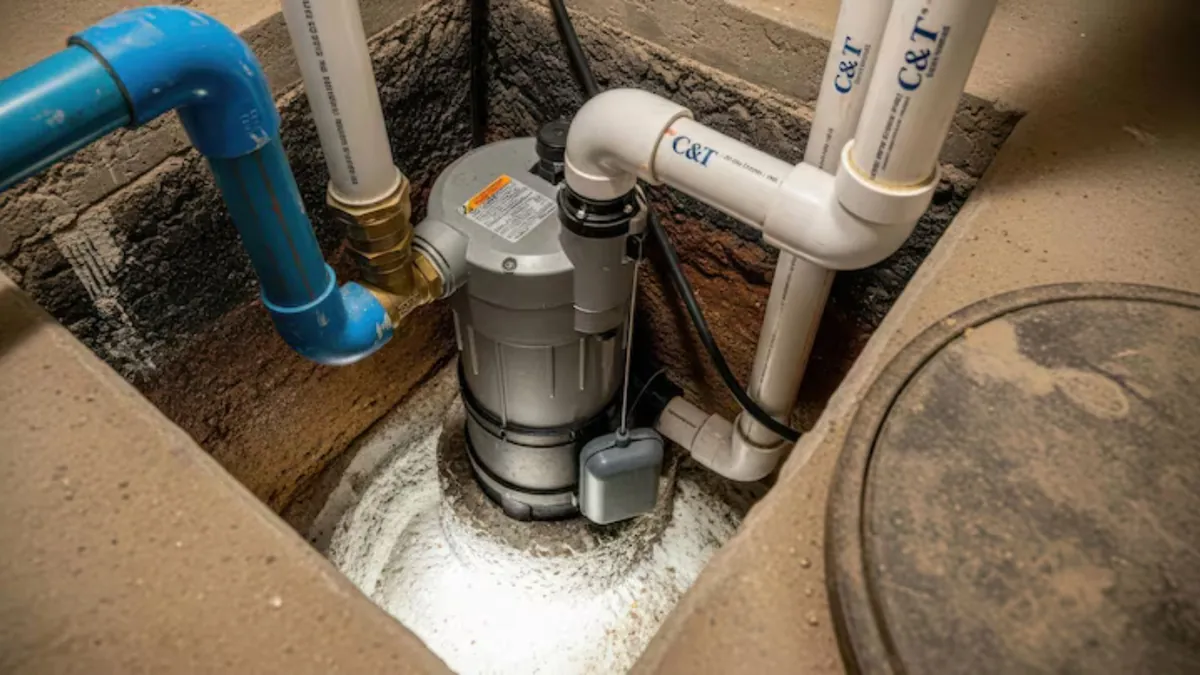
Backup pump types compared
Each option solves a different failure. Match the backup to the way your main pump is most likely to let you down.
| Type | How it works | Best fit | Main limit |
|---|---|---|---|
| Battery backup | Runs on a deep-cycle battery when power drops | Homes where outages come with storms | Battery has a limited run time and needs replacing |
| Water-powered | Uses pressure from the house water supply to move water | Pits without space for a battery | Needs city water pressure and drains water as it works |
| Second electric pump | Sits in the same pit and kicks in at a higher level | Heavy water flow with steady power | Does nothing in a power outage |
| Generator-fed system | Runs the main pump from a generator | Homes that already own a generator | Needs someone to start it, and fuel on hand |
| Alarm only | Sounds when water gets too high | Added to any of the above | Warns but does not pump |
Many setups combine two of these. A common pairing is a primary pump with a battery backup and a high-water alarm.
What a primary pump failure usually looks like
A pump can fail from a stuck float, a clogged intake, a burned-out motor or a blocked discharge line. It can also be fine and simply have no electricity. Those are different problems, and a backup only helps with some of them.
If your primary pump is already acting up, repair it or replace it first. Our sump pump repair work covers floats, check valves and failing motors, and a backup added to a bad main pump only hides a problem that will return.
Age matters too. An old pump near the end of its life will fail at the worst time, so a backup install is a good moment to ask whether the main unit should be replaced.
Sizing the backup and the pit
Pump capacity is measured by how much water it moves against the height it must lift it, called head. A backup that is too small may run all night and still fall behind during a hard storm.
The pit has to hold both pumps with room for each float to swing freely. A pit that is too narrow causes floats to tangle, which is a common reason two pumps fail together.
Ask your installer what size pit you have, how high the discharge must lift the water, and how fast the pit fills in heavy rain. Those three numbers decide the equipment, not a catalog default.
Discharge: where the water goes matters
A sump pump pushes water out through a discharge line, and that line needs a safe place to end. Dumping it right next to the foundation sends the same water back toward the pit, and a line that freezes or clogs can stop the whole system.
A check valve in the line keeps water from flowing back into the pit when the pump shuts off. A second pump should have its own check valve and its own path into the discharge, rather than sharing a fitting in a way that lets one pump push water backward through the other.
Many homeowners ask if sump water may go into a sewer drain. That is a question for local authorities, not a guess, and we cover it in the Millville section below.
Alarms, testing and battery care
A backup pump you never test is a hope, not a plan. Put these on a calendar.
- Pour a bucket of water slowly into the pit and watch the main pump turn on and clear it.
- Unplug the main pump briefly to confirm the backup starts and moves water.
- Check that floats move freely and are not resting against the pit wall or each other.
- Look at the battery terminals for corrosion and read the charger status light each month.
- Test the high-water alarm so you know it works and can be heard from where you sleep.
- Inspect the discharge outlet outside for leaves, ice or debris that could block flow.
- Replace the battery on the maker's schedule, following the manufacturer instructions.
Power outages and why storms are the test
The same storms that flood a pit often knock out power. A backup that depends on the same electric supply as the main pump fails at exactly that moment.
If outages are your concern, a battery or water-powered backup is a better match than a second electric pump.
Discharge and permit questions to ask in Millville
The city does not publish a rule on sump discharge that we can point to, and permit requirements depend on the job. The Millville Construction Office at City Hall, 12 South High Street, is open Monday to Friday, 8:30 am to 4:30 pm, and posts the state plumbing subcode form. Call before connecting a discharge line to anything other than an outdoor outlet.
The Millville Sewer Utility is the other call. Its staff handle questions about the sewer main, and you can ask whether sump water may enter the sanitary system. Do not assume yes, since stormwater in a sewer line is something many utilities limit.
Source type: City of Millville Construction page and Sewer Utility page.
When to install one: before the storm, not during
If your pit has flooded before, the pump runs all the time in wet weather, or you have a finished basement, the cost of failure is high enough to justify a backup now. Water already in a basement is hard to fight from the outside, and our related basement waterproofing work looks at the water source rather than just the pit.
We serve Millville and nearby towns, including homes around Port Norris and Bridgeton. Sump work is scoped with a clear price before work starts.
Questions People Ask
A working pump still depends on power and a float that can stick. If a failure would flood a finished space or damage stored items, a backup is cheap protection compared with the loss.
It depends on the battery size, the pump and how often it cycles. A heavy storm can drain a battery faster than a light one, so ask the installer for run time at your expected flow.
Yes, since it runs on water pressure rather than electricity, as long as your home still has water pressure. It uses household water to move the water out, so check your supply source before choosing it.
Often yes, if the pit is wide enough for both floats to move freely. Each pump should have its own check valve and a clear path into the discharge.
Do not assume so. Rules vary, and stormwater in a sanitary line is something many utilities restrict. Ask the sewer utility before connecting anything.
Start with the Millville Construction Office for permit questions and the Millville Sewer Utility for questions about sending water into the sewer system. Both are reached through the City Hall main line.
Sources and standards
These are the references behind the guidance on this page. Rules and contacts change, so confirm details with the agency.
- New Jersey Uniform Construction Code, plumbing subcode (the Millville Construction Office posts the permit form)
- State Board of Examiners of Master Plumbers, Division of Consumer Affairs, for checking any plumber's license
- City of Millville Sewer Utility guidance on laterals, cleanouts and sewer overflows